
The WhatsApp Business Platform is streamlining its pricing structure to make messaging costs more transparent and predictable for businesses. These updates simplify billing, encourage better customer experiences, and reflect the value delivered through WhatsApp business communications. Understanding WhatsApp API costs is crucial as Meta transitions from free Service Messages and Utility Message Templates within the 24-hour customer service window to a new per message charge basis starting from Oct 2026. In this guide, we explain the latest WhatsApp Business pricing updates, including template message pricing, authentication message rates, and what these changes mean for businesses using the WhatsApp Business API.
💡Key Takeaways: WhatsApp Business API Pricing Latest Updates and Cost Changes
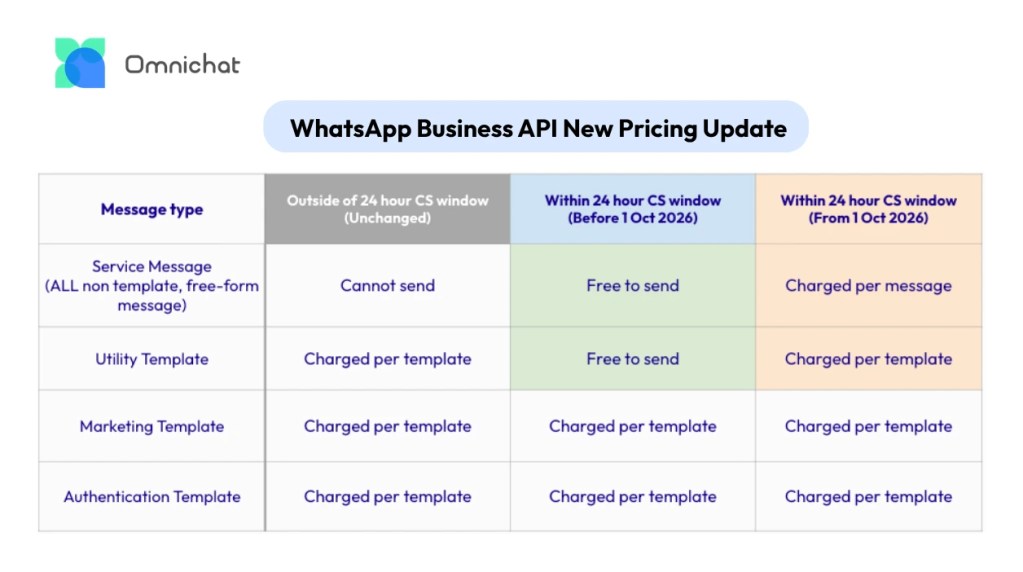
・Starting October 1, 2026, both Service Messages and Utility Message Templates sent within the 24-hour customer service window will incur charges per message/ template.
・Pricing depends on the message category and recipient country, with four categories defined by Meta: marketing, utility, authentication, and service.
・Businesses can reduce costs through free messaging windows, including the 72 hour Free Entry Point window from Click to WhatsApp ads or FB page CTA button.
・Businesses typically access the WhatsApp Business API through a Business Solution Provider such as Omnichat, which enables automation, multi agent support, and CRM integration.
In this guide, we explain the latest WhatsApp Business pricing updates, including free service conversations, template message pricing, authentication message rates, and what these changes mean for businesses using the WhatsApp Business API.
WhatsApp Business API Pricing Overview
WhatsApp Business API pricing is based on the type of template message businesses send to customers. Meta currently categorises template messages into three main types:
• Marketing messages
• Utility messages
• Authentication messages
For pricing purposes, WhatsApp defines four message categories: Marketing Messages (used for promotions and offers), Utility Messages (transactional updates such as order confirmations), Authentication Messages (one time passwords and verification codes), and Service Messages (customer support and issue resolution within the 24 hour customer service window). Each category has its own pricing structure and use case, which influences how businesses plan their messaging strategies.
Meta is transitioning WhatsApp Business Platform pricing from a conversation based model to a per template message pricing model starting July 2025. Under this structure, businesses are charged for each approved template message sent, with pricing determined by the message category and the recipient’s country code, not the sender’s.
Previously, sending a template message opened a 24 hour business initiated conversation window, during which businesses could send unlimited additional messages without extra charges. The new model simplifies billing by charging per template message instead of per conversation window. Non template messages sent within the 24 hour customer service window remain free, while template messages sent outside this window incur charges.
Businesses can still benefit from free messaging windows, such as the 24 hour customer service window triggered when a user sends a message. During this period, businesses can send free form messages, and starting July 2025 utility template messages sent within the service window will also be free.
Another feature is the 72 hour Free Entry Point window, which begins when a customer initiates a conversation through Click to WhatsApp ads or certain call to action buttons. During this period, businesses can send messages without incurring template messaging charges.
To access the WhatsApp Business API, businesses must work with a Business Solution Provider (BSP), as Meta does not provide direct access with a user interface. BSPs may charge setup fees, monthly platform fees, or usage based charges in addition to WhatsApp’s message delivery fees.
Understanding these pricing components helps businesses optimise messaging strategies and manage costs when using the WhatsApp Business API.
Here’s a breakdown of the fundamental changes:
WhatsApp Business API Service Messages & Utility Message Templates Charging
- Effective Date: October 1, 2026
- Change: According to the official announcement from WhatsApp, starting October 1, 2026, both Service Messages and Utility Message Templates sent within the 24-hour customer service window will incur charges per message/ template.
- Service message fee will be charged at the same rate as Utility and Authentication Message template.
- Service Messages: All non-template replies including live support agents, keyword auto-replies, chatbot interactive button responses, individual chatbot dialog messages triggered within automated customer journeys, and automated WhatsApp order confirmation pop-ups.
72-Hour Free Entry Point Window
When a customer initiates a conversation by clicking a Click-to-WhatsApp Ad (CTWA) or a Call-to-Action (CTA) button on a Facebook Page, and the brand replies within 24 hours, Meta grants a 72-hour free messaging window starting from the moment of the brand’s first reply. During this 72-hour period, all kinds of messages (both template and service messages) are completely free!
Note: The “24-hour customer service window” and the “72-hour free entry point window” operate on two independent timers. If the 24-hour customer service window expires, the brand can only send template messages, but those templates remain free within the remaining 72-hour entry point window.
Per-Message Pricing:
- Effective Date: Businesses will be transitioned to per-message pricing from July 1, 2025
- What it means: Meta is simplifying its pricing for WhatsApp Business Platform. Starting July 1, 2025, businesses will be charged per template message rather than 24-hour conversation. Each pre-approved message you send (marketing, utility, or authentication) will incur a fee. Previously, sending a template message opened a 24-hour conversation window, allowing for unlimited free-form messages within that period. This could lead to confusion as multiple active windows with different ending times overlap. The new per-message pricing model eliminates this complexity and offers a more straightforward billing structure.
Expansion of Authentication-International Rates:
- Effective Date: February 1, 2025
- Change: Authentication-international rates, which apply to specific message types sent to certain countries, will be expanded to include seven additional markets as below:
- Egypt
- Malaysia
- Nigeria
- Pakistan
- Saudi Arabia
- South Africa
- United Arab Emirates
Commencing on April 1, 2025, individuals in the per-message pricing Phase 1 group will experience a change in the eligibility threshold for authentication-international rates. This change entails a shift from the number of authentication conversations opened to the number of authentication messages sent as the determining factor. This modification will apply across all nine markets that have authentication-international rates.
What These WhatsApp Business Pricing Changes Mean for Businesses
Key points to remember:
- 72-Hour Free Entry Point: Businesses can respond to customer-initiated inquiries without incurring additional messaging costs, enhancing the customer support experience.
- Service Messages & Utility Templates Pricing: Encourages businesses to streamline chatbot steps and frontline responses to avoid message fragmentation.
- Per-template message pricing: Use template messages strategically to manage expenses, especially when you need to re-initiate contact with customers after the 24-hour window by sending pre-approved marketing templates.
- Craft impactful templates: Marketing teams should focus on creating engaging and effective marketing templates for promotional content, and categorize messages correctly—using utility templates for transactional messages to avoid unnecessary costs.
- Optimise the customer journey: Foster customer engagement and build strong customer relationships by leveraging strategic messaging across multiple channels throughout the customer journey.
- Leverage AI agents: Use AI agents to automate responses and maintain conversation flow, helping to resolve issues efficiently and reduce messaging costs.
- Adjust budget for authentication rates: Factor in updated rates for secure messaging actions.
- Follow Omnichat: Stay informed about WhatsApp updates and optimise your messaging strategy.
Stay ahead of the curve with Omnichat. As WhatsApp evolves, businesses that adapt quickly will gain a competitive advantage. By staying informed on the latest updates, you can optimise your messaging strategy to deliver efficient and cost-effective customer service, enhance customer engagement, and strengthen customer relationships throughout the customer journey. Follow Omnichat for expert insights and strategies to help you stay ahead of the curve.
How Omnichat Helps Businesses Manage WhatsApp Business API Pricing
Omnichat is an Official WhatsApp Business API Solution Provider (BSP) helping brands implement WhatsApp messaging for customer service, marketing automation, and conversational commerce.
With Omnichat, businesses can:
• Get WhatsApp Business API access and support multiple agents to efficiently manage message operations across teams
• Enable sending WhatsApp messages through the API as part of a multi channel strategy; startups with limited budgets can also leverage EngageLab for usage based pricing
• Automate marketing broadcasts and customer journeys
• Track messaging performance and costs
• Integrate WhatsApp with CRM and e commerce systems
Book a Consultation