
March is a traditional low season for the retail industry. Rather than spending heavily on ads to acquire new customers, the smartest growth strategy lies within your existing database: your “dormant members”—those who already know your brand but haven’t visited in a while. In the age of AI, we no longer need to “blindly” blast broadcast messages. Instead, we can use WhatsApp automation features like replenishment reminders and limited-time coupons to proactively predict demand, achieve precision segmentation, and reactivate dormant members to maintain high conversion rates even during the off-season.
Key Takeaways: Low Season WhatsApp Marketing
・Re-engage Dormant Customers: Use WhatsApp automation (Auto-tagging and Limited Coupons) to precisely activate members who already know your brand but haven’t visited recently.
・Predict Demand Proactively: Use Automated Customer Journeys to send reminders based on consumption cycles, securing orders before the customer even thinks to look elsewhere.
・Restock Notifications: Provide WhatsApp Restock Notifications for popular items to transform lost intent into automated sales.
Strategy 1: Chatbot Auto-Tagging for Low Season Precision
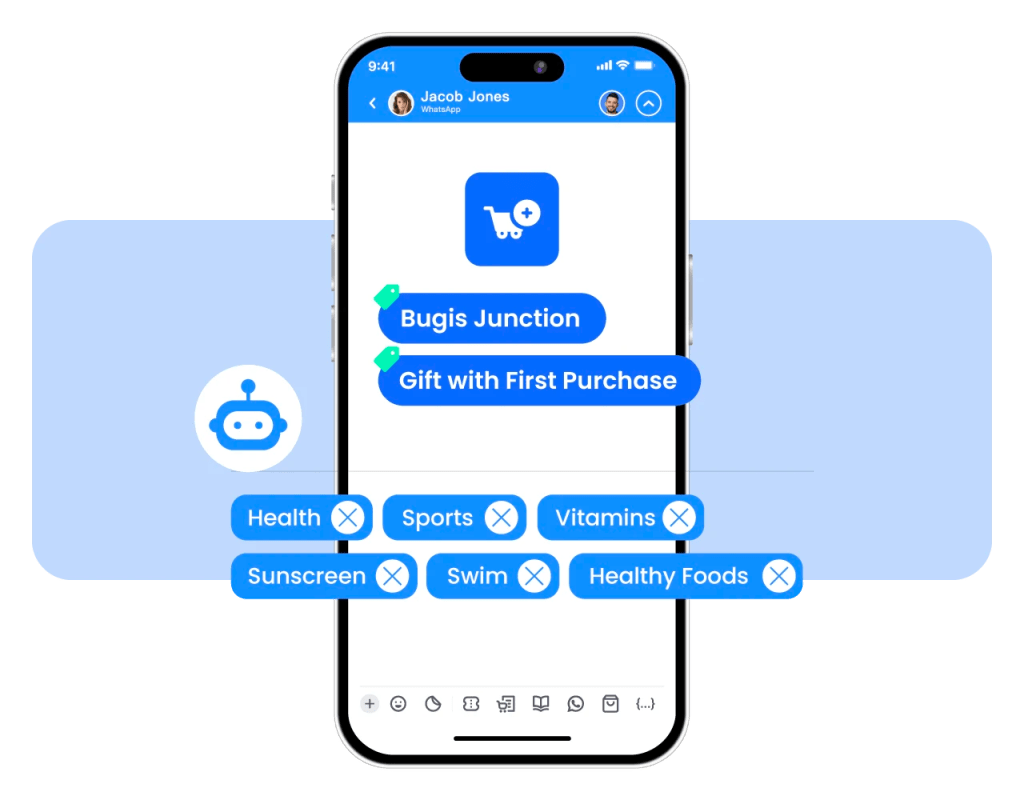
Traditional member classification is often limited to basic profile data. Omnichat’s Chatbot Auto-Tagging feature captures a customer’s real-time intent and preferences through chatbot interactions.
The system applies tags based on real-time behavior. For instance, when a customer clicks a broadcast message, the system instantly tags their related interests. This allows the system to automatically identify and categorise preferences for specific product styles, functions, or price ranges, building a more multi-dimensional customer profile.
Example: A fashion brand sends a “New Spring Outfits” broadcast. When a customer, “Xiao Ming,” clicks an interactive button, the system tags him with 【Interest: New Arrivals, Styling】. Knowing that Xiao Ming usually buys every season but has been inactive for six months, the brand sends him an exclusive “New Collection Preview” instead of a generic clearance discount. This high-relevance content successfully recaptures his attention and drives a conversion.
Strategy 2: Upgrading to “Custom Attributes” for Precise Audience Segmentation
While simple tags can record interests, they often become cluttered and difficult to manage over time. To capture low-season opportunities more accurately, brands can utilise Omnichat’s “Custom Attributes” feature.
Instead of just applying static tags, this feature allows you to create fixed data fields (such as Last Purchase Date, Member Level, Remaining Points, and Cumulative Spend) that are automatically maintained by the system. These data points are dynamically updated whenever a customer interacts via WhatsApp.
Example: For dormant customers, the system can automatically filter for high-value members who “have not purchased for over 180 days” and “still have remaining points in their account.” You can then send a personalised WhatsApp reminder including their actual point balance. This real-time, data-driven automation ensures that every message sent during the low season is highly relevant, maximising conversion potential.
Strategy 3: Automated Customer Journeys – Reminders Before They Run Out
Low sales during the off-season often stem from a lack of immediate purchase triggers. Omnichat’s Automated Customer Journey feature triggers latent demand based on product consumption cycles.
- Predicting Replenishment Need: Set up automated workflows based on average product cycles (e.g., 90 days for a serum). The system can trigger a WhatsApp reminder just before the product runs out (e.g., on day 80).
- Shortening the Decision Path: Sending a message exactly when a customer needs a refill maximises repurchase rates and ensures steady cash flow during the low season.
Example: A skincare brand sets up an automated customer journey to target those who have purchased the ‘Hydrating Serum.’ Ten days before the product is expected to run out, the system automatically sends a WhatsApp message with an 85% off ‘Serum Repurchase’ discount and a free shipping reminder, accurately capturing the perfect timing for a repeat purchase.
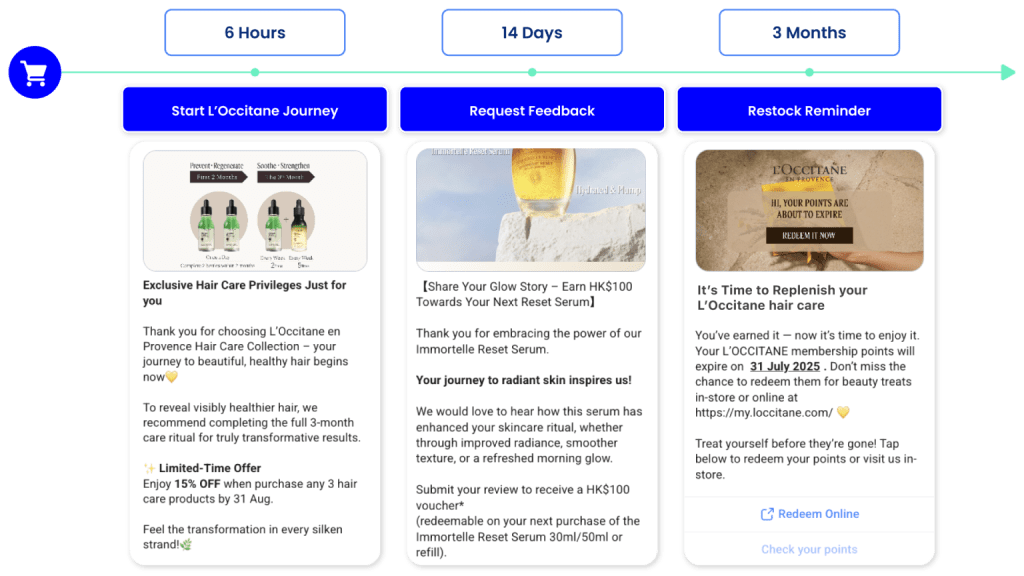
Case study: L’OCCITANE extended the conversation to build loyalty through a bespoke customer journey. Each customer received thoughtful touchpoints across several months. These timely, value-driven touchpoints kept customers engaged and respected throughout their lifecycle.
- 6 hours after purchase:
Customers received beauty care tips, exclusive offers, and encouragement to start their product ritual. - 14 days later:
A friendly WhatsApp message invited them to share feedback and earn a small reward, reinforcing the brand’s commitment to their voice. - 3 months later:
Customers received a restock reminder with a personalised offer, encouraging them to repurchase before their points expired.
Strategy 4: WhatsApp Restock Notifications – No More Lost Leads
Beyond predicting demand, WhatsApp Restock Notifications for hot items are crucial for retention. After peak seasons, popular items often sell out. Customers who have to manually check for restocks often give up out of convenience.
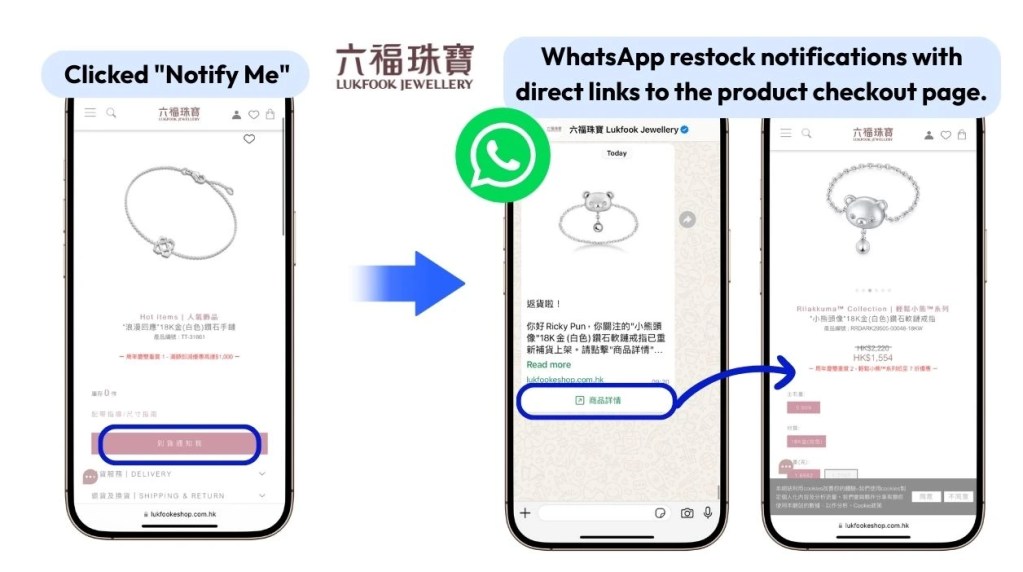
- The Feature: When an item is out of stock, customers can click a “Notify Me” button to register.
- Automated Notification: As soon as the item is restocked, the system notifies interested customers via WhatsApp, simplifying the shopping process and securing the purchase intent.
Example: A trendy sneaker brand’s “Urban Walker” model sold out, Peter couldn’t find his size and clicked “Notify Me” on the product page. A week later, when the system logged new stock (e.g., Classic White / Size 42), it automatically sent Peter a personalised WhatsApp notification. To accelerate conversion, the message included a “Buy Now” button for instant checkout and a “Restock Free Shipping” offer. This recovered the potentially lost lead and saved the customer from tedious manual checking.
Case study: Lukfook Jewellery utilises Omnichat’s WhatsApp Restock Notification feature. When a customer clicks ‘Notify me when available’ on the Lukfook website, the system automatically sends a WhatsApp notification once the item is back in stock. Customers can simply click the message to return to the product page, effectively converting purchase intent into actual sales.
Strategy 5: Limited Coupons – Boosting Low Season Urgency
For members tagged as “Dormant” or “Price Sensitive,” a little extra push is needed. Omnichat’s e-coupons feature uses “scarcity” to guide immediate conversions.
- Limited-Time/Quantity Strategy: Issuing a “$50 Voucher – Today Only, Limited to 50 Users” leverages the “fear of missing out” (FOMO) to encourage orders.
- Automated Follow-up: If a customer claims the coupon but hasn’t used it, the system can send an automated reminder 2 hours before expiration, significantly boosting conversion.
Example: To wake up price-sensitive dormant members (inactive for over 6 months), a brand uses Omnichat to trigger a “Low Season Surprise: 2 Days Only” $50 voucher. The message highlights the limited availability (e.g., “Only 15 spots left”), giving dormant customers a strong reason to “Buy Now.” The system monitors usage and sends a final reminder before expiry, turning hesitant dormant members into actual revenue.
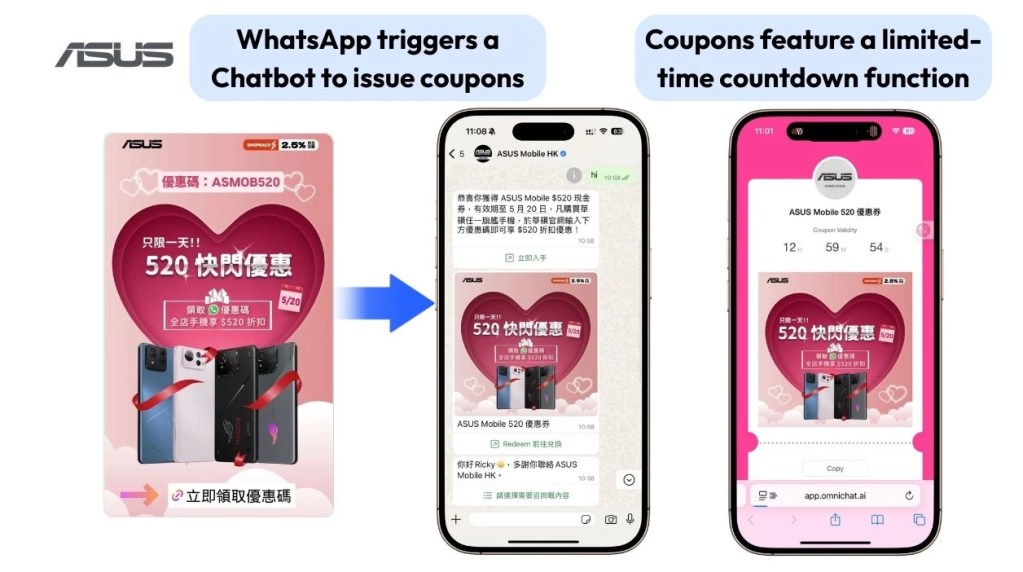
Case study: ASUS launched a ‘One-Day Only’ flash sale, using social media ads to drive customers to WhatsApp to claim promo codes. By simply clicking the ‘Redeem’ button in WhatsApp, customers are directed to a coupon page featuring a limited-time countdown timer, creating a sense of urgency to accelerate purchase decisions. Customers can then easily copy the code for use on the online store. This not only optimises the redemption experience but also allows the merchant to accurately track the conversion rate of every ad.
Conclusion: Turning Passive into Proactive with WhatsApp Automation
The secret to thriving in the low season is for a brand to act like a “thoughtful friend with a great memory.” Through Chatbot Auto-Tagging, you “remember” customer preferences; with Automated Journeys and WhatsApp Restock Notifications, you “proactively” appear exactly when they need you.
WhatsApp automation allows brands to stop struggling for new traffic and instead focus on saying hello at the perfect moment, in the way customers prefer, turning dormant members into long-term loyal supporters.
Book a Consultation