
In the realm of digital marketing, the 5A Model proposed by Philip Kotler has become the gold standard for managing the customer journey. This article provides an in-depth analysis of the 5A theory and demonstrates how to leverage Omnichat’s conversational marketing tools to automate customer engagement. From social media automated responses to abandoned basket recovery, we empower you to strike with precision across the stages of Awareness, Appeal, Ask, Act, and Advocacy, converting potential leads into devoted followers.
Article Summary: The 5A Marketing Model
・Definition: Developed by Philip Kotler, it divides the journey into Aware, Appeal, Ask, Act, and Advocate, highlighting the influence of social circles and social media.
・Automated Growth Strategies:
・Aware Stage: Social media auto-replies and OMO QR code lead generation.
・Appeal Stage: Using site marketing triggers based on browsing behaviour to highlight product benefits.
・Ask Stage: Instant Chatbot replies for FAQs with live agent handover for high-value leads.
・Act Stage: Using abandoned cart recovery to reclaim lost orders.
・Advocate Stage: Integrating CRM data for targeted broadcasts to build long-term loyalty.
What is the 5A Model?
Traditional marketing funnels (such as AIDA) are linear. However, in today’s era of social media dominance, the consumer journey has become fragmented and non-linear. The 5A Model deconstructs the customer path into five stages: Aware, Appeal, Ask, Act, and Advocate.
The core insight of this theory is that consumer decisions are no longer purely individual; they are deeply influenced by social circles and social media. Brands must shift from traditional “inside-out” promotion to “outside-in” customer management, providing instant value at the pivotal “Ask” and “Act” junctions.

The Five Steps of the 5A Model
1. Awareness: Building the First Impression
- Theoretical Core: Customers learn about a brand through passive exposure, commercial advertising, or third-party recommendations. This is the entry point for traffic; the key is capturing these prospects efficiently at a low cost.
- Omnichat Automation:
- Social Media Auto-Reply: When a customer comments on a Facebook or Instagram post, a Chatbot can instantly send a Direct Message (DM) with offers or information. This converts “passing” social traffic into trackable leads on WhatsApp or LINE.
- OMO Offline-to-Online: Place WhatsApp QR codes in stores. Upon scanning, customers are automatically connected to the brand’s WhatsApp account to claim offers, turning passive awareness into an active online connection.
2. Appeal: Strengthening Brand Attraction
- Theoretical Core: After receiving numerous brand messages, customers filter their options. They are drawn to brands with a unique “memory point”. At this stage, brands must proactively create a strong appeal to ensure they are shortlisted by the consumer.
- Omnichat Automation:
- Site Marketing Messages: Set automated triggers based on browsing behaviour. For instance, if a customer lingers on a specific product page, the Chatbot can pop up with a limited-time offer or highlight key product benefits to reinforce the brand’s appeal.
3. Ask: Critical Information Gathering and Interaction
- Theoretical Core: Driven by curiosity, customers begin to actively gather data, seek advice from friends, and read online reviews. If a query is not met with an immediate response, the desire to purchase cools down, and the customer may turn to a competitor. Professionalism and immediacy are vital here.
- Omnichat Automation:
- 24/7 Chatbot: Instantly resolve 70% of repetitive queries (e.g. stock availability, delivery times). Instant replies demonstrate reliability and build initial trust.
- Human-Agent Handover: The system automatically tags and routes complex inquiries to a live agent, ensuring high-value customers receive a personalised, one-to-one service.
4. Act: Driving Decision-Making and Optimising Experience
- Theoretical Core: If convinced during the “Ask” stage, the customer decides to act. It is crucial to note that “Action” is not limited to the purchase itself. After ordering, customers interact further through consumption and after-sales service. Brands must ensure customers feel empowered and enjoy a positive, memorable experience.
- Omnichat Automation:
- Abandoned Cart Recovery: If a customer adds items to their basket but fails to checkout, Omnichat can send an automated reminder to help them overcome obstacles and complete the purchase.
5. Advocate: Cultivating Long-term Loyalty and Word-of-Mouth
- Theoretical Core: Over time, customers develop strong brand loyalty, reflected in retention, repeat purchases, and recommendations to others. Brands must proactively manage after-sales service and feedback; this is the key to turning a customer into an “Advocate”.
- Omnichat Automation:
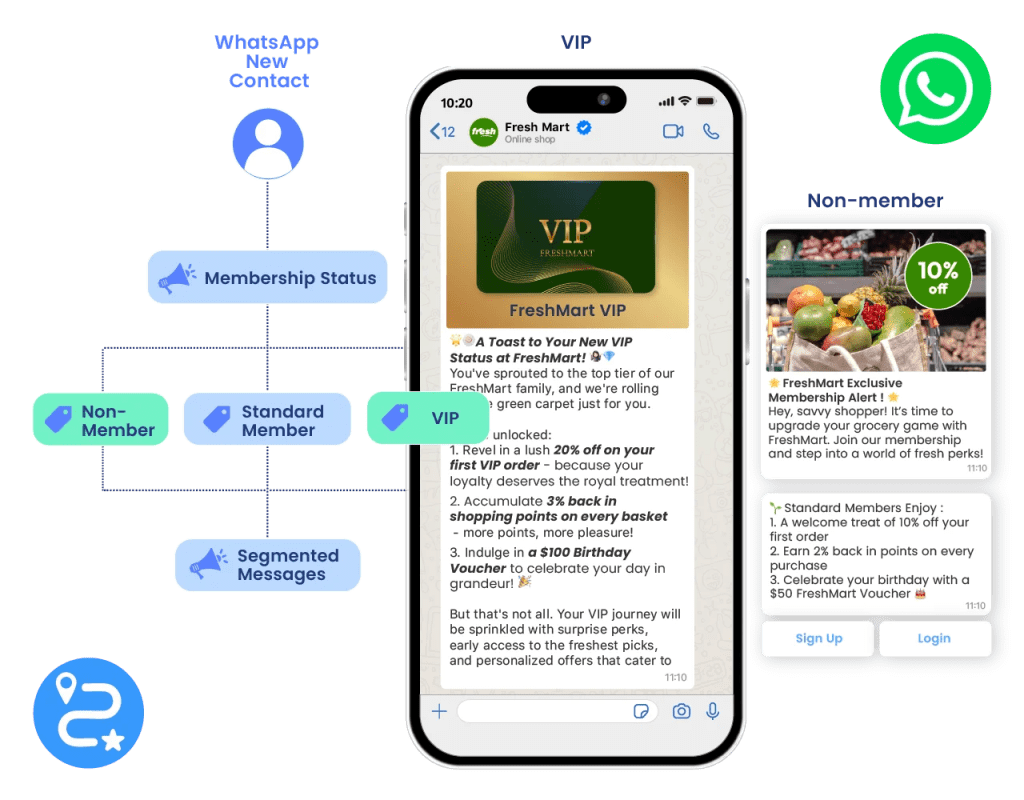
- Automated Customer Journeys: Integrate with e-commerce platforms and CRM data to automatically send offers based on spending and membership tiers, encouraging repeat business.
- Targeted Broadcasts: Send personalised offers based on customer tags (e.g. style preference, purchase cycle) to increase brand affinity.
Case Study: How Brands Optimise the 5A Model
- Aware: A customer sees an ad for a new autumn collection on Instagram and leaves a comment.
- Appeal: The Chatbot instantly DMs a lookbook, enhancing the product’s aesthetic appeal.
- Ask: The customer visits the website and asks about sizing; the Chatbot provides an immediate recommendation based on the database.
- Act: The customer completes the purchase. Upon delivery, they receive a WhatsApp message with a product care video and after-sales FAQs, ensuring a positive and professional user experience.
- Advocate: The brand monitors feedback. When the customer leaves a positive review, the Chatbot automatically sends a referral reward, encouraging them to recommend the brand to friends.
Conclusion
The 5A Model is more than just a textbook theory; it is a strategic blueprint for online retailers. Brands must ensure that customers feel empowered and receive a high-quality experience at every touchpoint. Continued engagement after the “Act” stage is the core of building long-term brand value. Through Omnichat’s conversational marketing technology, you can integrate fragmented customer service and marketing activities into an automated engine for growth.
Book a Consultation