
Artificial Intelligence (AI) is fundamentally revolutionizing the e-commerce industry by introducing groundbreaking solutions that automate tasks, generate valuable data insights, and improve retailers’ bottom lines. With over 35% of companies adopting AI by 2023, the retail sector is leveraging advanced algorithms to analyze customer demographics and browsing behaviors, resulting in hyper-personalized product recommendations that boost conversion rates and foster brand loyalty. Beyond personalization, AI-driven chatbots and virtual assistants provide 24/7 support to resolve queries instantly, while sophisticated predictive models optimize inventory management, demand forecasting, and pricing strategies to ensure operational efficiency. Additionally, AI bolsters security through real-time fraud-detection systems that identify suspicious patterns, protecting both businesses and consumers from financial losses. Ultimately, as AI technology continues to advance, its pivotal role in streamlining operations and redefining the customer journey ensures it will remain the primary architect of the future online shopping landscape.
💡 Key Highlights of the Future of AI in Online Shopping
– The AI market in online shopping is projected to reach $16.8 billion by 2030 as retailers shift toward hyper-personalization and automated 24/7 service.
– Omnichat helps businesses integrate AI-powered chatbots and conversational commerce tools to bridge the gap between browsing and buying across multiple social channels.
– Retailers using these e-commerce AI solutions see conversion rates increase by up to 15% and a 25% reduction in product returns through better customer guidance.

Hyper-Personalized Retail Experiences

Artificial intelligence (AI) is revolutionizing online shopping by enabling retailers to curate highly personalized shopping experiences. By meticulously analysing vast customer data, including browsing history, purchase patterns, and demographic information, AI algorithms can discern individual preferences and tailor product recommendations accordingly. This level of personalization enhances the customer experience and drives significant business results. Research indicates that AI-powered personalization has substantially increased e-commerce revenues, ranging from 10% to 15% (Birch, 2022).
The impact of AI on personalization strategies is undeniable. Most business leaders acknowledge that AI will fundamentally reshape how they approach personalization. By leveraging AI’s capabilities, retailers can deliver product recommendations that are highly relevant to each shopper, thereby increasing the likelihood of conversion. This personalized approach fosters customer engagement and loyalty, as customers feel understood and valued by the retailer.
Furthermore, 73% of business leaders agree that AI will fundamentally reshape personalization strategies (Segment, 2024). By tailoring these elements to individual preferences, retailers can create a unique and compelling shopping journey for each customer. As AI technology advances, we can expect to see even more sophisticated and impactful personalization applications in e-commerce.
24/7 Support with AI Chatbots
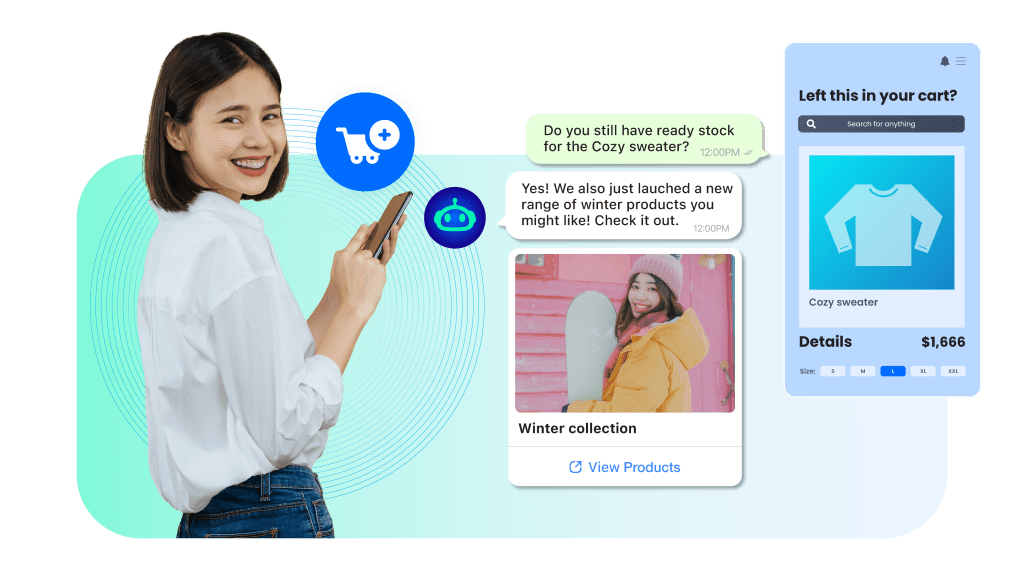
A significant advantage of AI chatbots and virtual assistants is that they provide round-the-clock support, ensuring customers can receive assistance whenever needed, regardless of time zones or business hours. This accessibility improves customer satisfaction and helps businesses build trust and loyalty among their clientele. Moreover, as AI technology advances, these virtual assistants are becoming increasingly sophisticated at understanding and responding to customer needs, making them an indispensable tool for businesses looking to stay ahead in the competitive online shopping landscape.
Importantly, research suggests that many consumers are comfortable interacting with AI-powered chatbots if their needs are effectively met. A recent study by HubSpot (2025) found that 40% of consumers are indifferent about whether they receive assistance from a chatbot or a human agent, highlighting the growing acceptance and effectiveness of AI-driven customer service solutions in online shopping.
Smarter Inventory & Supply Chain

Artificial intelligence is profoundly transforming supply chain management, with a particular emphasis on inventory optimization and efficiency. By leveraging AI’s predictive capabilities, businesses can anticipate demand fluctuations and proactively manage their stock levels, thus mitigating the risks of overstocking or stockouts. This intelligent inventory management approach reduces carrying costs and ensures that products are readily available to meet customer demand, enhancing customer satisfaction and loyalty.
Furthermore, AI’s ability to analyze vast datasets and identify patterns enables businesses to optimize their supply chain operations from end to end. AI empowers enterprises to enhance their supply chain agility and responsiveness by streamlining processes, identifying bottlenecks, and predicting potential disruptions. This translates into faster order fulfillment, shorter lead times, and greater operational efficiency. The significant impact of AI on supply chain management is underscored by the fact that over 50% of supply chain organizations have recognized its transformative potential and have prioritized investments in AI for their warehousing and distribution divisions (KPMG, 2024). This strategic investment in AI streamlines operations and drives revenue growth, enabling businesses to deliver products to customers more quickly and efficiently.
Visual Search & Smart Recommendations

AI-powered visual search enables customers to find products using images, enhancing the shopping experience. Additionally, AI-driven recommendation systems analyze user behavior to suggest products, increasing sales and customer satisfaction. AI-powered visual search transforms the online shopping experience by enabling customers to search for products by image rather than text. This technology analyses the content of an image and returns visually similar products, making it easier for customers to find what they’re looking for. For example, a customer could take a picture of a dress they saw in a magazine and use a visual search to find similar dresses online.
Moreover, AI-driven recommendation systems are also changing the way customers shop online. These systems analyze user behavior, such as past purchases and browsing history, to suggest products the customer might be interested in. This can help customers discover new products and make more informed purchase decisions. A McKinsey & Company study found that 35 percent of Amazon’s revenue comes from its recommendation engine.
AI for Fraud Detection & Security

AI systems are crucial in detecting fraudulent activities and enhancing cybersecurity in online transactions. By analyzing vast amounts of data and identifying patterns and anomalies, AI can quickly flag suspicious activities such as unusual purchase patterns, multiple transactions from the same IP address, or high-risk locations.
AI algorithms can also detect fraudulent behavior by analyzing user data, such as login credentials, device information, and behavioral biometrics. For example, if a user’s login behavior suddenly changes, such as typing speed or mouse movements, AI can flag this as a potential sign of account takeover.
Moreover, AI can continuously learn and adapt to new fraud patterns, making it difficult for fraudsters to stay ahead. By analyzing historical data and identifying emerging threats, AI can proactively detect and prevent fraud before it occurs. In addition to detecting fraud, AI can enhance cybersecurity by identifying vulnerabilities in online systems and networks. AI can identify potential weaknesses by analyzing network traffic and system logs and recommend solutions to prevent cyberattacks.
Overall, AI plays a critical role in ensuring the safety and security of online transactions. By detecting fraud, enhancing cybersecurity, and continuously adapting to new threats, AI is helping create a safer online shopping environment for consumers.
The Rise of Voice Commerce

The increasing popularity and use of voice-activated assistants, such as Amazon’s Alexa and Google Assistant, have opened the door to a new era of voice commerce. This innovative approach to shopping lets consumers make purchases, track their orders, and even receive personalized product recommendations with voice commands. This hands-free, intuitive shopping experience significantly enhances consumer convenience. With the growing adoption of smart speakers and other voice-enabled devices, the number of US voice assistant users is expected to rise steadily from 145.1 million in 2023 to 170.3 million in 2028.
This upward trend represents a compound annual growth rate (CAGR) of 3.3%, indicating a promising future for voice commerce and its potential to reshape the online shopping landscape (eMarketer, 2024).
AR & Virtual Try-Ons

The integration of Artificial Intelligence (AI) with Augmented Reality (AR) has ushered in a transformative era in online shopping, particularly in the realm of virtual try-on (VTO) technology. This innovative approach allows customers to interact with products in a simulated environment, virtually trying on clothing, accessories, or makeup before purchasing.
By offering a realistic and immersive shopping experience, VTO bridges the gap between online and in-store shopping. It enables customers to visualize how products will look and fit, enhancing customer confidence and satisfaction and significantly impacting retailers’ bottom lines. A study by Accenture has revealed that VTO technology can significantly reduce return rates by up to 25%. This decrease in returns translates into considerable cost savings for retailers, as it mitigates expenses associated with logistics, restocking, and handling returned merchandise.
Furthermore, by minimizing the environmental impact of returns, VTO contributes to sustainable retail practices. The fusion of AI and AR in virtual try-on technology is reshaping the online shopping landscape, offering a win-win solution for both customers and retailers. By enhancing the shopping experience and promoting informed purchase decisions, VTO fosters customer loyalty while driving operational efficiency and sustainability for businesses (Metadome.ai, 2023).
The Future of E-commerce

AI is fundamentally reshaping online shopping by enhancing personalization, operational efficiency, and security. With the AI-enabled e-commerce market projected to reach $17.1 billion by 2030, retailers are leveraging machine learning to analyze vast datasets for tailored recommendations and 24/7 chatbot support.
Beyond the customer interface, AI streamlines supply chains through predictive demand forecasting and real-time logistics tracking. As emerging technologies like visual search and augmented reality virtual try-ons become standard, businesses that integrate these AI solutions will be best positioned to meet evolving consumer expectations and thrive in an increasingly competitive landscape.
Book a Consultation