Routine chores like processing invoices, responding to repetitive queries, and updating data often consume a significant amount of a team’s valuable time, limiting their focus on high-value strategic work. As AI technology advances, the core of corporate competitiveness is shifting—from relying solely on “automation tools” to “hiring” cognitive AI Employees (Digital Workers). This article explores the definition, core advantages, and how businesses can integrate this future workforce to stay competitive in a rapidly changing business environment.
What is an AI Employee (Digital Workforce)?
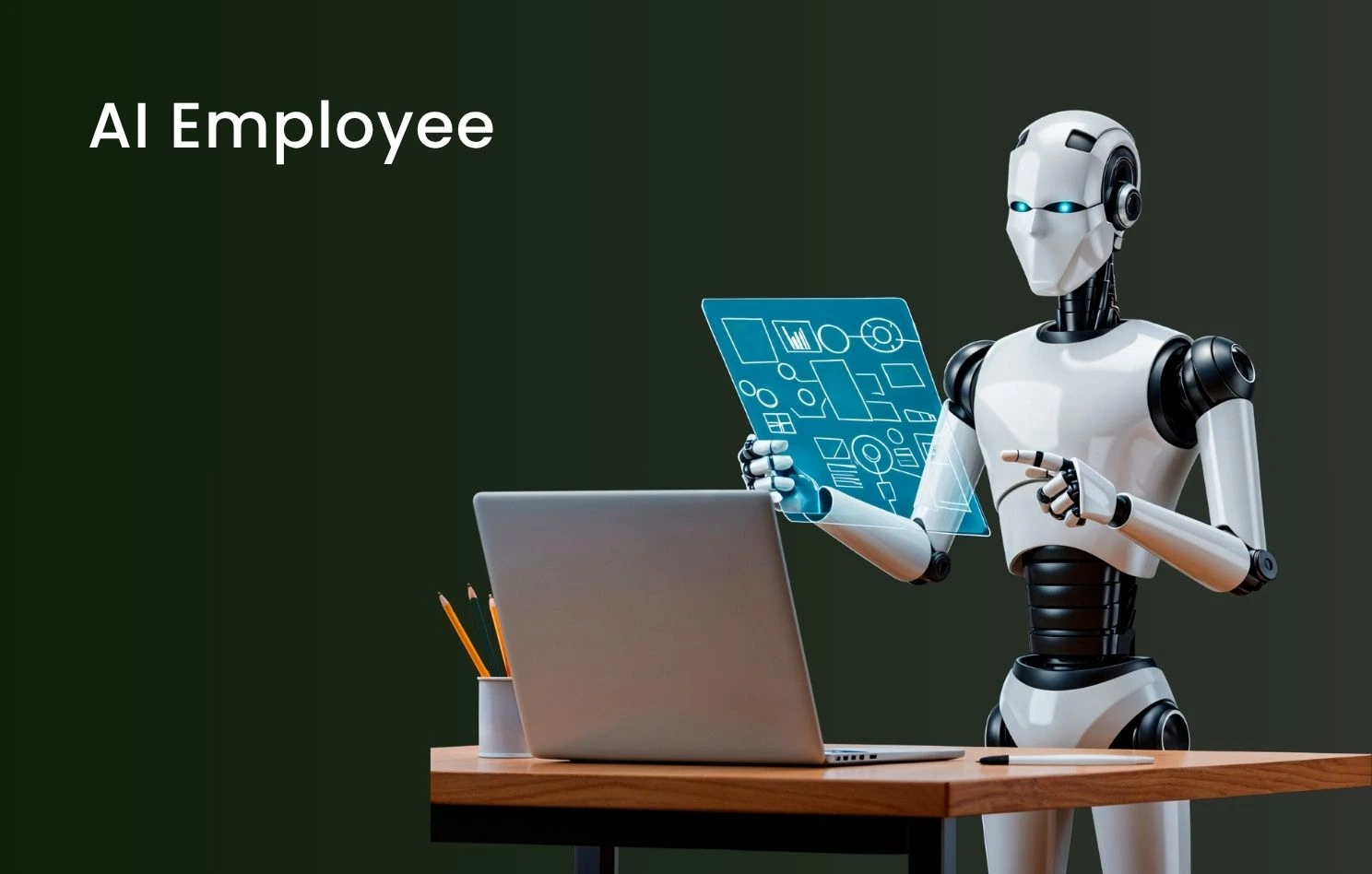
An AI Employee is a virtual workforce built on Artificial Intelligence, Machine Learning, and Natural Language Processing (NLP). Unlike traditional software, digital workers can understand, judge, and execute complex tasks. They possess a “digital identity” and can handle emails, answer customer questions, analyze complex data, and even collaborate autonomously across different systems to complete end-to-end business processes.
Benefits of Hiring AI Employees (Digital Workforce)
- 24/7 Continuous Operation: AI employees never rest. They handle cross-timezone tasks, ensuring businesses can respond to market demands in seconds at any time.
- Flexible Scalability: During peak seasons or major promotions, AI employees can instantly “clone” themselves to handle massive volumes of inquiries without the need for lengthy recruitment and training.
- Unleashing Human Creativity: By taking over repetitive, data-intensive tasks, AI employees allow human staff to focus on creative, emotional, and strategic work, boosting overall productivity.
- Reducing Error Rates: Digital workers strictly follow logic and knowledge bases, eliminating errors caused by human fatigue while providing accurate revenue forecasts through real-time data analysis.
How Do AI Employees (Digital Workforce) Differ from Traditional Automation?
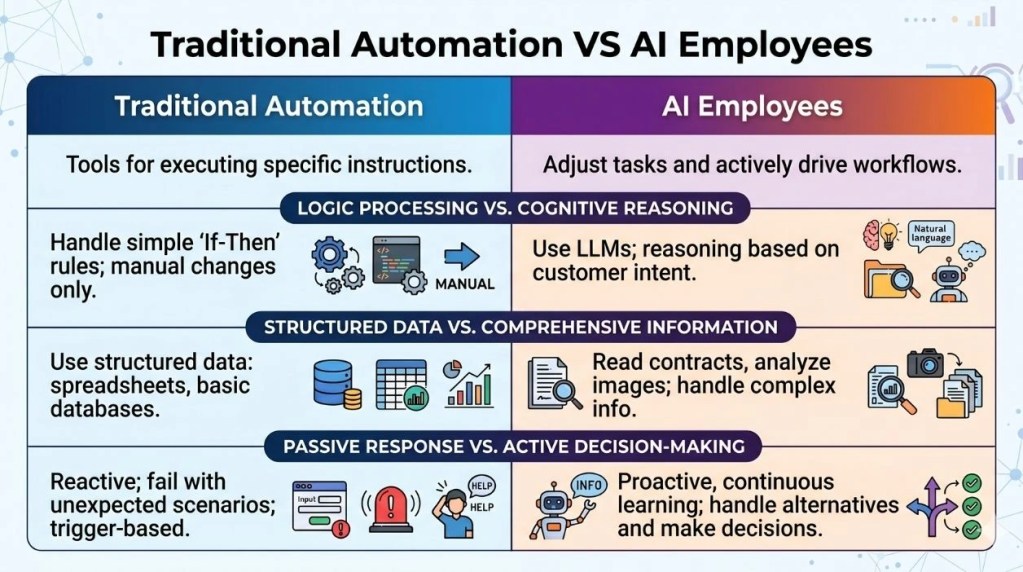
While traditional automation (like RPA and basic Chatbots) are tools for executing specific instructions, AI employees are thinkers capable of adjusting tasks and actively driving workflows.
Logic Processing vs. Cognitive Reasoning
Traditional tools rely on “If-Then” rules; changing a process requires manual reconfiguration. AI employees use Large Language Models (LLM) to understand vague contexts and incomplete info, reasoning based on customer intent.
Structured Data vs. Comprehensive Information
Traditional tools only handle structured data like Excel. AI employees can read contracts and analyze images, making them ideal for complex processes with shifting variables.
Passive Response vs. Active Decision-Making
Traditional bots are trigger-based and often fail when encountering unexpected scenarios. AI employees learn continuously from feedback, proactively attempting alternative solutions and making decisions between different paths.
AI and Humans: What Can Be Replaced and What Cannot?
AI Employees excel at:
- Repetitive tasks: Data entry, lead screening, and appointment reminders.
- Reviewing vast information: Finding precise answers from thousands of pages of legal or technical documents.
- Real-time translation: Switching between local languages and nuances instantly when communicating with global customers.
Irreplaceable Human Values:
- Empathy & Emotional Connection: In complaints or high-trust scenarios like counseling, human warmth is irreplaceable.
- Ethical & Moral Judgment: Complex decisions involving legal risks or brand reputation still require human oversight.
- 0-to-1 Innovation: AI finds the best solutions within existing data, but disruptive creativity remains a human patent.
Applications of AI Employees Across Fields
AI employees can take on specific responsibilities tailored to the unique challenges of different departments. Below are the real-world applications of digital workers across major core functions:
Sales
- Lead Follow-up: AI employees interact with potential customers 24/7, overcoming human physical limitations. They automatically analyze a lead’s company size, industry, and tech stack, scoring and routing them to the appropriate sales team based on preset rules, and even scheduling meetings directly for sales representatives.
- Sales Forecasting & Analysis: By analyzing massive amounts of historical data to identify patterns, AI employees can tailor personalized sales proposals for potential clients and assist management in formulating long-term strategies.
Customer Service
- Instant Query Resolution: When a new inquiry enters the system, the AI employee automatically reads the content, retrieves relevant data from the knowledge base and CRM, and tags/categorizes the ticket by issue type and urgency. For common issues like address changes, password resets, or order tracking, it can execute the task directly to improve response speed.
- Suggested Handling Methods: For high-risk or complex cases, the AI employee writes a summary and suggests next steps before escalating the matter to a human agent, thereby shortening resolution time.
Marketing
- Omnichannel Content Generation: Based on simple concepts or notes, AI can automatically generate EDMs, social media posts, or ad copy. It can also repurpose long-form assets (such as webinar videos) into short-form content suitable for various channels.
- Personalized Marketing & Evaluation: AI analyzes customer behavior data to enable precise segmentation for personalized marketing. It also automatically pulls performance metrics from various tools to write campaign summaries and provide optimization suggestions.
Human Resources (HR)
- Intelligent CV Screening: AI employees can scan thousands of resumes, categorizing candidates into groups such as “Strong Fit” or “Potential Fit” based on job requirements, and provide comments explaining the reasoning behind each classification.
- Automated Administrative Tasks: Handling onboarding, payroll management, contract generation, and leave requests.
- Instant Employee Inquiries: Assisting employees with queries regarding company policies or benefits, reducing response times from “days” to “minutes.”
Build Your AI Workforce via Omnichat Omni AI Message Flow
When it comes to practical execution, businesses often encounter bottlenecks in “content creation” and “workflow design.” Omnichat has officially launched Omni AI Message Flow specifically to break down these technical barriers. Powered by advanced Agentic AI technology, the system can transform a simple concept into a fully automated conversational marketing campaign within seconds. Its core features include:
Instant Onboarding: AI Employees Automatically Learn Brand Style
To ensure human-level execution, Omni AI simplifies “onboarding” by learning your brand’s style, knowledge base, and tone directly from your website URL. This ensures all auto-generated messages strictly adhere to brand guidelines, maintaining a consistent and exclusive brand voice in every customer interaction.
Auto-generated Marketing Copy and Conversational Workflows
Unlike traditional drag-and-drop tools that are time-consuming and template-bound, Omni AI Message Flow autonomously generates complete message architectures, logic, and creative assets based on your goals. This goal-oriented approach turns abstract ideas into live campaigns in seconds, significantly boosting conversion rates.

Advanced Image Generation via AI Studio
To boost engagement, Omni AI’s built-in AI Studio lets teams generate or edit professional images directly within the flow editor. It automatically optimizes formats for WhatsApp, Instagram, Facebook, and LINE, ensuring assets are ready for immediate use without the need for external design tools.
Shifting from Passive Response to Actively Driving Performance
Omni AI introduces true “AI Employees”—autonomous agents that move beyond passive replies to understand complex business logic and manage entire workflows. As a seamless extension of your team, they operate 24/7 to proactively execute tasks and drive performance, enabling enterprises to achieve rapid, large-scale transformation.
Book a Consultation