In today’s highly competitive e-commerce landscape, many Hong Kong online shop owners find that while running ads brings in traffic, the conversion rate into actual orders is lower than expected. To break through performance bottlenecks, the core key lies in establishing and optimising a complete Online Sales Funnel.
Key Points: E-commerce Sales Funnel
Sales Funnel: Don’t just chase traffic; you must manage all five stages from awareness to retention.
Measure Success: Regularly monitor KPIs to find where customers drop off and optimise accordingly.
Omnichat Features: Utilising Omnichat to automate the funnel is the best choice for increasing conversion rates.
What is an E-commerce Sales Funnel?
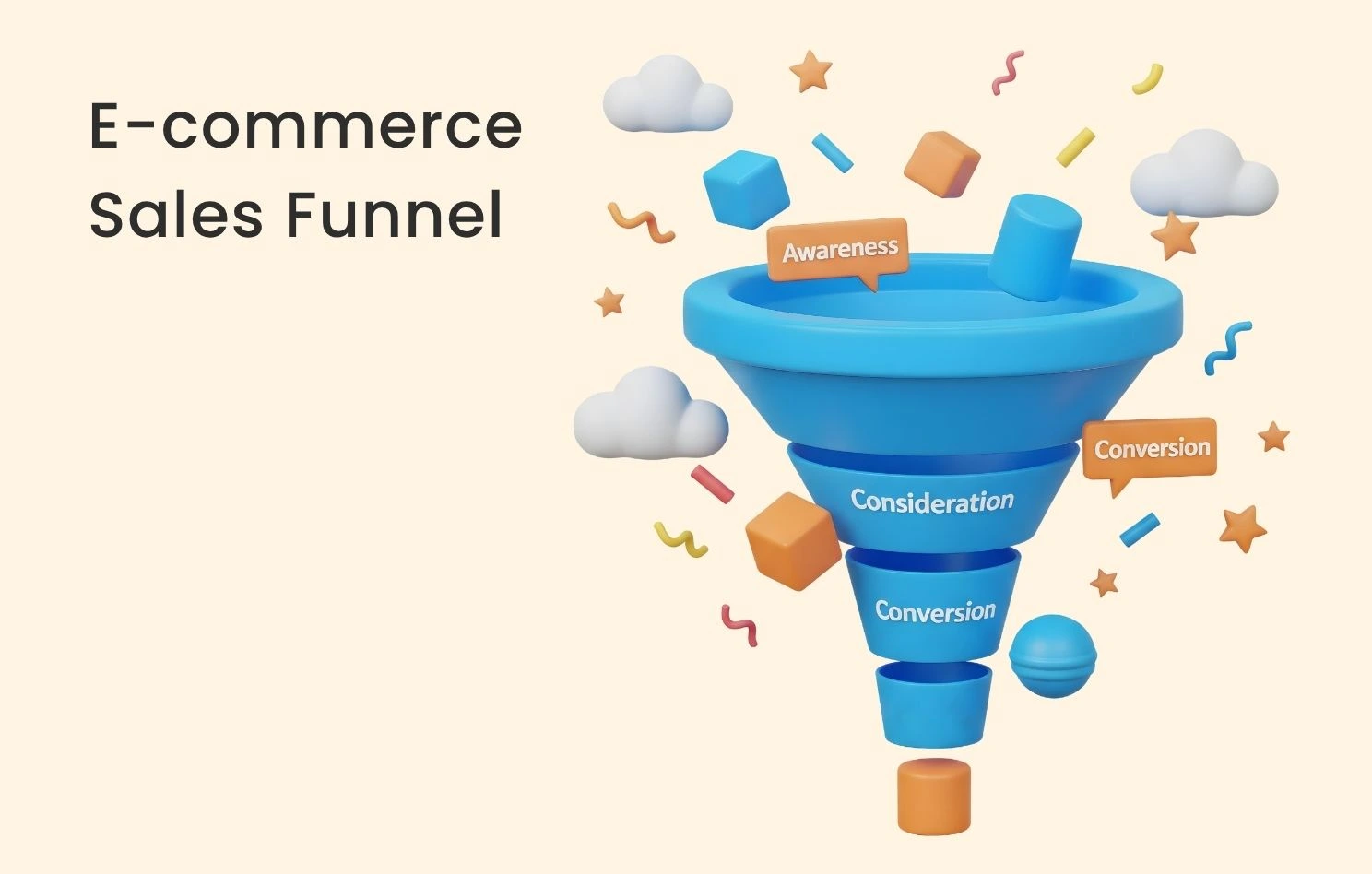
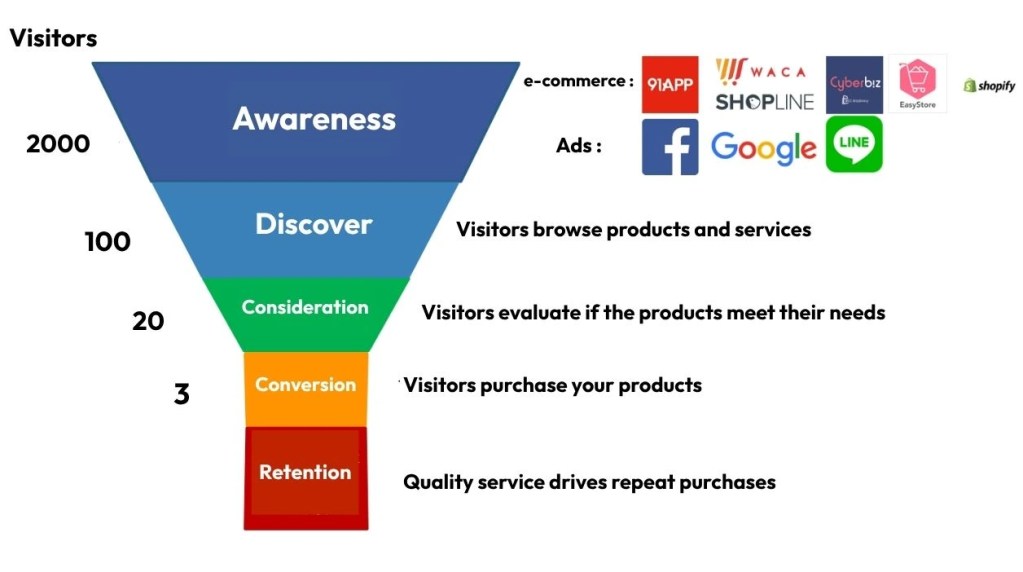
An online sales funnel is a marketing concept that visualises the journey a potential customer takes with a brand, from initial awareness to the final purchase. Because users drop off at each stage, the number of final transactions is smaller than the initial exposure, creating a funnel shape that is wide at the top and narrow at the bottom.
Suppose Awareness brings your online store and products to about 2,000 people, and Discovery leads approximately 100 people to enter your site. Around 20 people then move to Consideration because they are interested in your products, but only about 3 people actually complete a purchase. In this scenario, the average online store conversion rate is 3%.
Simply put, the funnel is a process of “filtering” and “converting.” The goal of a store owner is to use strategies to reduce drop-offs at every stage and guide visitors toward a successful transaction at the bottom of the funnel.
Why Should Online Stores Execute a Sales Funnel Strategy?
Implementing a complete sales funnel strategy offers significant advantages:
- Improved Return on Investment (ROI): When you understand where customers drop off, you can allocate your budget precisely instead of blindly spending on ads.
- Building Brand Trust: Consistent communication through each stage—rather than just price wars—helps customers identify with the brand and builds long-term loyalty.
- Data-Driven Decision Making: The sales funnel provides clear data points, allowing owners to optimise based on specific conversion rates rather than intuition.
- Gaining Deeper Insights: A funnel strategy collects behavioral data at different stages, assisting in more precise marketing in the future.
Breaking Down the Five-Layer E-commerce Sales Funnel
To deeply optimise online store performance, you must understand every link of the five-layer funnel:
Layer 1: Awareness
This stage targets strangers who are completely unfamiliar with your brand. Customers are usually in an “unconscious” or “searching for solutions” state and do not yet have an intent to buy.
- Core Goal: Maximise reach and establish a first impression.
- Strategy: Focus on content marketing, such as creating educational short videos (e.g., FB/IG Reels), running precise ads, and writing tutorial articles on the store blog to solve potential customer problems.
- Example: An ergonomic chair store releases a Reel titled “5 Tips to Improve Long-term Sitting Back Pain,” attracting clicks from a large number of office workers suffering from back issues.
Layer 2: Discover
After being attracted by the first layer, visitors click into the site. Their psychology shifts to curiosity and exploration as they want to understand brand style, pricing, and reviews.
- Core Goal: Lower the Bounce Rate and guide visitors to view more product pages.
- Strategy: Optimise the UI/UX of the store to ensure clear categorisation. Use a “Brand Story” and prominent “Top Product Banners” to retain visitors.
- Example: A user clicks from IG to the website and sees clear categories like “Office Series” and “Gaming Series,” alongside a slogan stating “Recommended by over 10,000 HK office workers,” deciding to browse further.
Layer 3: Consideration
This is the most critical hesitation period before conversion. Visitors are comparing and evaluating, calculating shipping costs, referencing reviews, and considering after-sales warranties.
- Core Goal: Eliminate doubts and build deep trust.
- Strategy: Show visitors real positive reviews and unboxing clips. Use instant customer service to proactively answer specific inquiries regarding warranties, color differences, etc.
- Example: A customer hesitates while looking at a chair worth $3,000. A chat box automatically pops up offering real customer testimonials and promising a “5-year HK warranty,” increasing purchase confidence.
Layer 4: Conversion
The customer is ready to check out but is in a final stage of “struggle.” Any cumbersome process will lead to cart abandonment.
- Core Goal: Remove all payment barriers and ensure a smooth transaction.
- Strategy: Provide diverse payment methods (Credit Card, PayMe, FPS, Alipay, etc.) and simplify checkout forms.
- Example: A customer stops payment because they cannot find their credit card. 15 minutes later, the system detects the incomplete transaction and automatically sends a WhatsApp message: “The items in your cart are still here! If you don’t have your card, you can click the link below to use PayMe or FPS for one-click payment.” The customer completes the payment immediately, successfully recovering a potential order.
Layer 5: Retention
The funnel does not end at checkout. Customer psychology shifts to “anticipation and brand loyalty,” hoping for personalised attention.
- Core Goal: Increase Customer Long-term Value (LTV) and trigger repeat purchases.
- Strategy: Provide high-quality after-sales service, precise new product broadcasts, and set up member birthday discounts.
- Example: Three months after receiving the product, the customer receives a WhatsApp message asking for feedback and including an exclusive returning customer discount coupon, attracting them to buy related accessories.
How to Measure Sales Funnel Effectiveness?
Owners should monitor Key Performance Indicators (KPIs) for each of the five stages to identify drop-off points:
Layer 1 (Awareness): Measuring Reach Efficiency
- Click-Through Rate (CTR): Measures if the ad creative is attractive enough.
- Cost Per Click (CPC): Evaluates if the cost of traffic is within budget.
- Cost Per Mille (CPM): Monitors the cost of brand exposure in the market.
Layer 2 (Discover): Measuring Visitor Engagement
- Product Page Views: Observes if visitors are exploring specific products.
- Cost Per Visit: Calculates the total marketing spend to evaluate the actual cost of bringing a visitor to the site.
- Bounce Rate: Reflects if the homepage or Landing Page can retain visitors.
Layer 3 (Consideration): Measuring Interaction Depth
- Time on Site: Longer stay times indicate customers are studying product info.
- Inquiry Rate: The ratio of people inquiring via WhatsApp or Live Chat; a key indicator of trust.
- Add-to-Cart Rate: Measures the willingness to move from “thinking” to “acting.”
Layer 4 (Conversion): Reflecting Final Sales Performance
- Conversion Rate: The ratio of completed orders to total visitors.
- Cart Abandonment Rate: Measures drop-offs at the final checkout stage; key for optimising payment flow.
- Average Order Value (AOV): Reflects the effectiveness of upselling strategies.
Layer 5 (Retention): Measuring Long-term Profitability
- Retention Rate: The frequency of repeat orders from existing customers.
- Lifetime Value (LTV): The total revenue a customer contributes over their relationship with the brand.
- CAC to LTV Ratio: Compares Customer Acquisition Cost (CAC) to LTV. A healthy store should have an LTV significantly higher than CAC.
How Omnichat Helps Online Store Owners
Manually handling every funnel stage is no longer sufficient. Omnichat helps owners automate the sales funnel:
- Post Auto-Reply & DM Conversion: Automatically sends a DM when customers comment on FB/IG, quickly pushing them from “Awareness” to “Discover.”
- Instant Service & Chatbots: Triggers automated dialogues based on browsing behavior and uses 24/7 Chatbots to handle inquiries instantly.
- Multi-Team Collaboration: Supports multiple teams managing complex Facebook, Instagram, and WhatsApp conversations simultaneously.
- WhatsApp Cart Abandonment Recovery: Automatically sends WhatsApp messages to customers who left items in their cart to remind them to complete the payment.
- Social CDP Cross-Platform Data Integration: Integrates customer profiles across platforms and automatically applies interest tags for precise broadcasting during the “Retention” stage.
Book a Consultation