In 2026, with advertising costs skyrocketing, relying solely on paid traffic is no longer enough to sustain growth. Smart store owners are shifting their focus to Conversion Rate Optimisation (CRO). This article deep dives into 5 core secrets to improving your conversion rate—from UI/UX and loading speed to AI live chat, cart recovery, and omnichannel automated messaging—helping you maximise every cent of your ad budget and turn visitors into customers.
Key Takeaways: Guide to Conversion Rate Optimisation
・Conversion Rate: The core metric for operational efficiency; improving it lowers CAC and allows the same ad budget to generate double the revenue.
・5 Secrets: UI/UX optimisation, site speed, proactive chat, cart recovery, and personalised omnichannel marketing.
・Omnichat Features: Behavior tracking, segmented tagging, personalised broadcasts, cart remarketing, and Social CDP integration.
What is Online Store Conversion Rate?
Conversion rate refers to the percentage of total website visitors who successfully complete a purchase. The average conversion rate for a typical retail online store generally ranges between 1% – 3%.
The Conversion Rate Formula:
Conversion Rate = (Total Orders ÷ Total Website Visitors) x 100%
For example, if your store attracts 100 visitors in a day and 20 of them place an order, your conversion rate is 20%. This represents an extremely high-efficiency performance where 1 out of every 5 customers makes a purchase.
It is important to note that conversion rates are not a “one-size-fits-all” metric; they fluctuate based on several factors:
- Unit Price: High-ticket items (e.g., jewelry, luxury watches, or gym memberships) have longer decision cycles and typically lower conversion rates.
- Purchase Frequency: Low-cost daily consumables generally have higher conversion rates due to lower barriers to entry.
- Platform Characteristics: Different e-commerce platforms or self-hosted sites attract different types of traffic, affecting final conversions.
You can use professional tools like Wordstream to check industry benchmarks and determine if your store is leading the pack or has room for improvement.
To increase turnover, most people instinctively increase ad spend, but this often leads to out-of-control Customer Acquisition Costs (CAC). A truly smart marketing strategy focuses on “Conversion Rate”—optimising the value of every visitor without increasing traffic costs. This is the key to doubling revenue and maximising profit.
5 Key Factors Affecting Conversion Rates
1. Optimise Website UI/UX
When a visitor first lands on your page, if they cannot find the information they need immediately, your Bounce Rate will soar. The first step in UI/UX optimisation is placing your most attractive promotions and limited-time offers in the Hero Section to instantly capture the customer’s attention.
Excellent UX (User Experience) is about reducing friction. Ideally, a visitor should be able to go from product discovery to checkout in 6-8 clicks. If the process is too cumbersome or the CTA (Call to Action) buttons are not prominent, you will lose potential customers.
Since we cannot rely on intuition alone to know which copy, color scheme, or layout resonates best with consumers, A/B Testing is the scientific way to improve conversion rates.
- How A/B Testing Works: Create different versions of a webpage for the same goal (e.g., testing different button colors or headlines) using tools like VWO. Systems split traffic equally, allowing you to select the “winning” version based on data reports.
2. Improve Website Loading Speed
Slow loading speeds lead to customer impatience—3 to 5 seconds is the limit. This also directly impacts SEO rankings, as Google will de-rank slow sites, leading to decreased traffic and conversions. Beyond checking external plugins, server location and image sizes are critical. Use the Google PageSpeed Tool for testing.
3. Proactive Live Chat
Many consumers stop browsing due to doubts—such as not finding a specific style or having questions about specifications. Unfortunately, most customers won’t ask for help; they simply close the page. While chatbots handle basic inquiries, the key to conversion is proactive engagement. By tracking which page a customer is on, you can send an automated message or a limited-time offer at the “golden moment” of hesitation to eliminate purchase resistance.
4. Abandoned Cart Recovery
In e-commerce, “Abandoned Carts” are the biggest obstacle to growth. The winning strategy lies in a robust retention plan. When a customer hesitates at checkout, provide an immediate incentive (like free shipping or a first-order discount). If they have already left the site, follow up with automated tracking messages to remind them of their unfinished order.
5. Precision Omnichannel Marketing
Data shows that returning customers’ annual spending power is 120% higher than new customers, with a significantly higher Average Order Value (AOV). As traditional EDM (Email Marketing) open rates decline, brands must break through via omnichannel integration—engaging customers on their preferred social platforms (like WhatsApp, Messenger, or LINE) with personalised content.
How Omnichat Boosts Your Conversion Rate
Omnichat supports integration with major platforms including Shopify, SHOPLINE, 91App, WooCommerce, Magento, EasyStore, and more. Beyond improving site quality, Omnichat helps owners through these core features:
1. Website Browsing Behavior Tracking & Marketing
Omnichat tracks visitors’ real-time behavior and preferences (pages viewed, visit frequency, dwell time) to display promotional messages at the right time. For example, if a customer is about to leave, the system triggers a “Personalised Offer” to capture attention at the critical moment, driving immediate orders without relying solely on paid ads.

2. Automated Segmentation Tags & Personalised Broadcasts
The system automatically categorises visitors based on behavior (e.g., interests, spending power, membership level). Owners can use these tags to send “Segmented Broadcasts” via WhatsApp, Facebook, and LINE, ensuring every customer receives content they are actually interested in, thereby increasing return visits and purchase completion.

3. Abandoned Cart Remarketing
For customers who add items to their cart but don’t check out, Omnichat automatically sends reminders via WhatsApp, Messenger, or LINE. Average abandoned cart recovery conversion rates reach 25%, offering much higher open and interaction rates than email. Reminders automatically include product images and info to increase click intent.

4. Social CDP: Building Omnichannel Customer Profiles
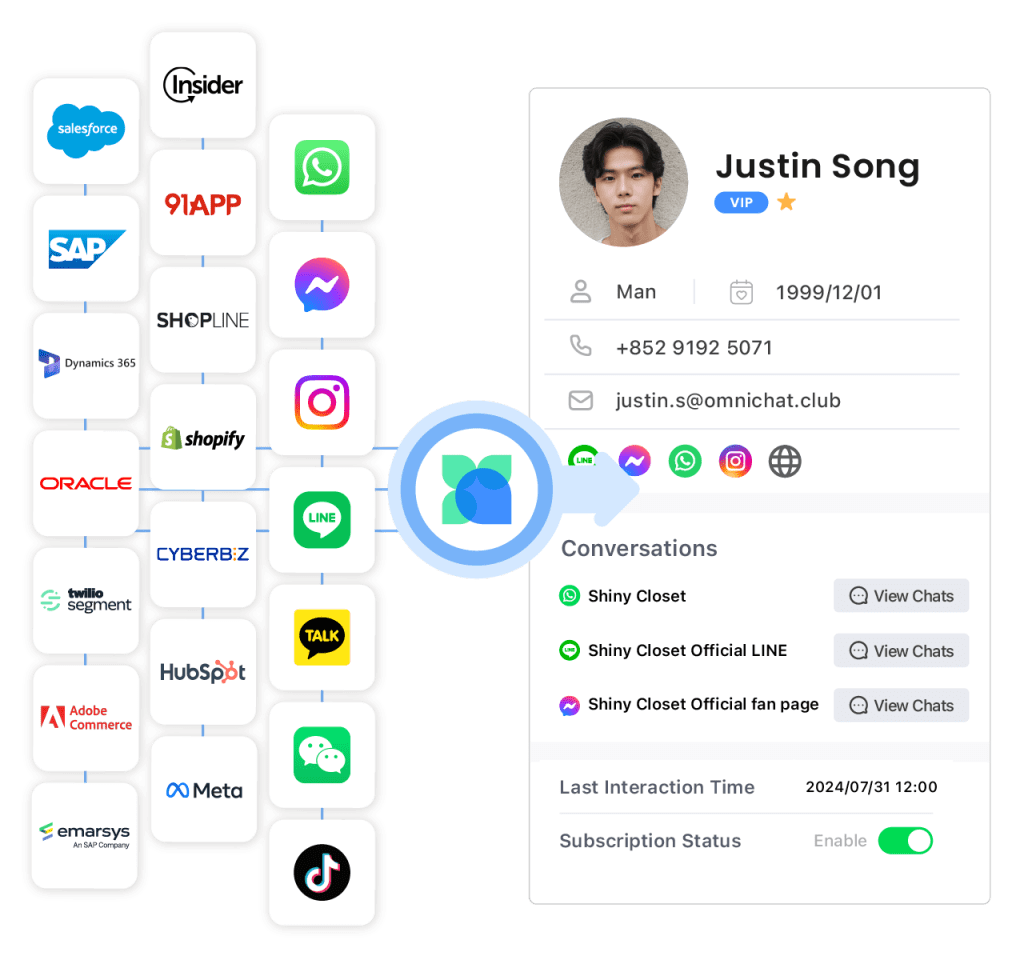
Omnichat’s Social CDP integrates data from WhatsApp, Facebook, Instagram, LINE, and your official website into one complete customer file. This allows marketing and support teams to have a 360° view of conversation history, spending habits, and preferences, providing a foundation for future personalised service.
Book a Consultation