Generative AI, a branch of artificial intelligence capable of autonomously creating content, is being widely adopted across various fields, including text, image, video, and music generation. Its benefits encompass enhanced content production efficiency, personalised marketing strategies, automated customer service, and reduced operational costs. Leading brands such as Amazon, Nike, and Netflix have already successfully leveraged AI to improve marketing performance and enhance the customer experience. However, businesses must also address challenges related to content quality control, the lack of human interaction, and potential copyright infringements.
As AI technology continues to advance, brands should actively explore the diverse applications of AI in digital marketing. These include AI-powered copywriting, AI chatbots, and AI-driven ad optimisation (incorporating A/B testing and dynamic creative generation), all of which contribute to enhanced competitiveness. While AI cannot currently fully replace human expertise and insight, the ability to effectively utilise AI-powered marketing tools is undeniably becoming a crucial factor in sustained brand growth.
What is Generative AI?
Generative AI is an artificial intelligence technology that utilises machine learning models (such as GPT, DALL·E, and Stable Diffusion) to create content, including text, images, videos, music, and even code. Unlike traditional AI, which focuses on data analysis and prediction, Generative AI possesses creative and automated production capabilities, generating high-quality, contextually relevant content, thus providing businesses with more flexible application scenarios.
Imagine having an exceptionally intelligent AI-powered virtual creative assistant. You provide clear instructions, such as: “Design a visual that represents my personal image. It should include elements of music and baseball, reflecting my profession in digital marketing, and portray a stylish individual around 40 years of age.” This virtual assistant would then, based on its vast database of learned information, rapidly generate a completely new image that matches your description. This is the core function of Generative AI.

Advantages and Challenges of Generative AI
Generative AI offers numerous advantages for commercial applications, steadily becoming a crucial tool across various industries. However, like all emerging technologies, it presents a duality, with associated challenges.
Advantages:
- Enhanced Content Production Efficiency: AI can automatically generate articles, social media posts, and product descriptions, significantly reducing the need for human resources.
- Enabling Personalised Marketing: Through automated analysis of user behaviour, AI facilitates the delivery of highly targeted product recommendations and advertising content.
- Diverse Creative Content Generation: AI can produce copy and designs in various styles, assisting marketing teams in expanding their creative horizons.
- Real-time Interaction and Customer Service: AI-powered chatbots can provide 24/7 responses to customer inquiries, improving the user experience.
- Reduced Operational Costs: Automated content generation and data analysis contribute to lower advertising, marketing production, and content creation costs.
Challenges:
- Content Quality Control: The quality of AI-generated content can vary. Larger enterprises, in particular, require rigorous quality control to ensure accuracy and brand consistency.
- Lack of Emotional and Human Connection: Although AI can mimic human tone, it struggles to genuinely comprehend consumer emotions, potentially leading to a perception of impersonal interaction.
- Potential Copyright Risks: Generative AI learns from vast datasets, and its output may inadvertently resemble existing copyrighted material, raising intellectual property concerns.
- Data Dependency: Accurate judgments and content require a combination of data, experience and contextual and market insights. Biased training data can lead to inappropriate or skewed content.
Industries suitable for Generative AI application
Numerous sectors are already utilising Generative AI to enhance efficiency and drive innovation. Some key application areas include:
- Digital Marketing and Advertising: Automated generation of ad copy, social media posts, and personalised recommendations to improve marketing effectiveness.
- E-commerce: Creation of product descriptions, user review summaries, and AI-powered customer service to enhance the shopping experience.
- Media and News: Automated writing of news summaries and blog posts, speeding up content production.
- Entertainment and Creative Industries: AI-generated music, illustrations, and scripts, providing inspiration and assistance to creators.
- Retail and Customer Service: Generation of personalised marketing messages and leveraging AI chatbots to improve customer satisfaction.
Applications of Generative AI in digital marketing and e-commerce
Automated content marketing
AI efficiently generates blog posts, social media posts (Facebook, Instagram, LinkedIn), product descriptions, etc., significantly boosting content output. Brands like Nike and Sephora have implemented AI to generate marketing copy and product descriptions, leading to improved conversion rates.
AI-powered personalised recommendations
AI analyses customer behaviour to recommend the most relevant products or services. Amazon and Netflix utilise AI recommendation systems to significantly increase sales and viewing time. Leading Taiwanese e-commerce platform momo leverages user history and preferences to automatically generate personalised offers, advertisements, and EDMs (Electronic Direct Mail), accurately targeting specific audience segments.
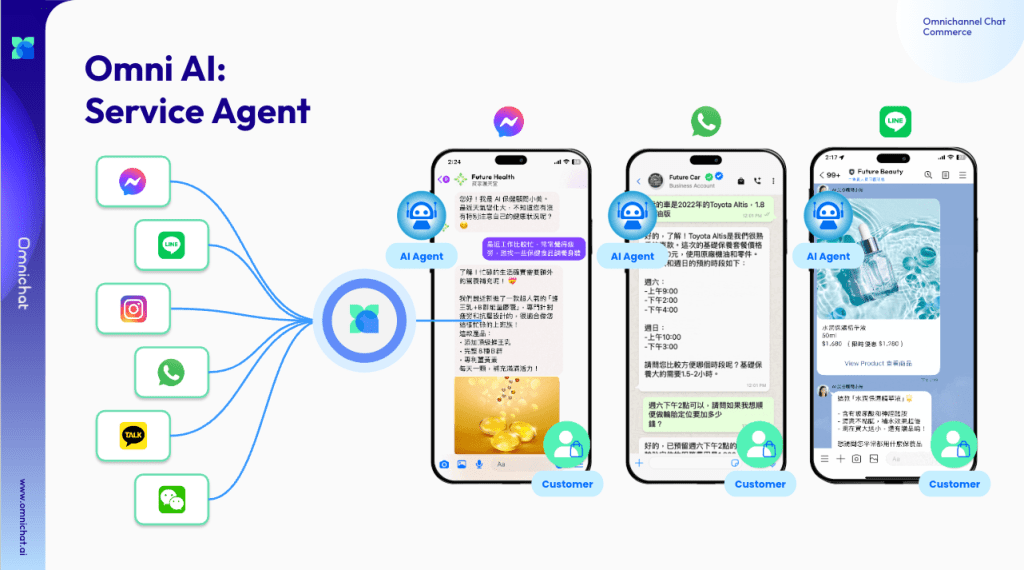
Omnichat is launching its Omni AI service, enabling businesses to easily integrate AI SaaS solutions without requiring in-house development, providing customers with personalised product recommendations.
AI chatbots and customer service
AI-powered customer service agents (chatbots) can respond to customer inquiries 24/7. Omnichat integrates with WhatsApp, Facebook Messenger, Instagram, and LINE, significantly enhancing customer service efficiency. AI can automate order inquiries, delivery tracking, and return requests, reducing labour costs and boosting operational efficiency.
AI-driven advertising optimisation and A/B testing
Google Ads and Meta Ads (Facebook advertising) have integrated AI to optimise ad delivery and improve ROI (Return on Investment). Omnichat also integrates with Meta Conversion API, providing brands with comprehensive insights into customer interactions, tracking each stage of the customer journey, and continuously refining ad targeting for optimal performance.
Furthermore, Generative AI can automatically create variations of ad headlines, copy, and images, conducting A/B tests to identify the best-performing combinations, increasing click-through rates and conversions.
The future of digital marketing: Generative AI?
Generative AI is spearheading a revolution in digital marketing and e-commerce. From content creation and automated customer service to personalised recommendations and ad optimisation, AI empowers brands to engage with consumers in a more efficient and creative manner. As AI technology continues to mature, businesses should proactively explore and adopt these tools, while carefully managing the quality and risks associated with AI-generated content. Maintaining brand integrity and consumer trust is paramount to thriving in this competitive landscape.
Is your business prepared for the age of AI-powered marketing? The time to explore the limitless possibilities of AI is now.
Omnichat is developing Omni AI, Generative AI, and Agentic AI technologies, all dedicated to helping businesses enhance productivity and achieve business growth.
Book a Consultation