Artificial intelligence (AI) is rapidly transforming the business landscape, and a new paradigm is emerging: Agentic AI as a Service (AaaS). This approach offers businesses a powerful and flexible way to integrate sophisticated AI capabilities into their operations without the need for extensive in-house expertise or infrastructure investment. Powered by large language models, an AI Agent within this model is designed to support reasoning and decision-making across business workflows.
💡 Key Takeaways: Agentic AI as a Service for Business
– Agentic AI as a Service (AaaS) is a subscription-based cloud model for deploying autonomous AI agents that can make decisions and execute tasks with limited supervision, often powered by large language models (LLMs).
– AaaS differs from SaaS and PaaS by delivering AI agent functionality that integrates into existing workflows via APIs, rather than a complete application or development platform.
– Key features of AaaS include scalability, cost-effectiveness, flexible configuration, API-based integration, and continuous model updates and improvement.
– Core benefits of AaaS include faster deployment, lower infrastructure costs, improved operational efficiency, stronger data-driven decision-making, and enhanced customer experiences.
– AaaS use cases span multiple industries, including retail, healthcare, finance, and manufacturing, where AI agents automate support, analytics, forecasting, and workflow execution.
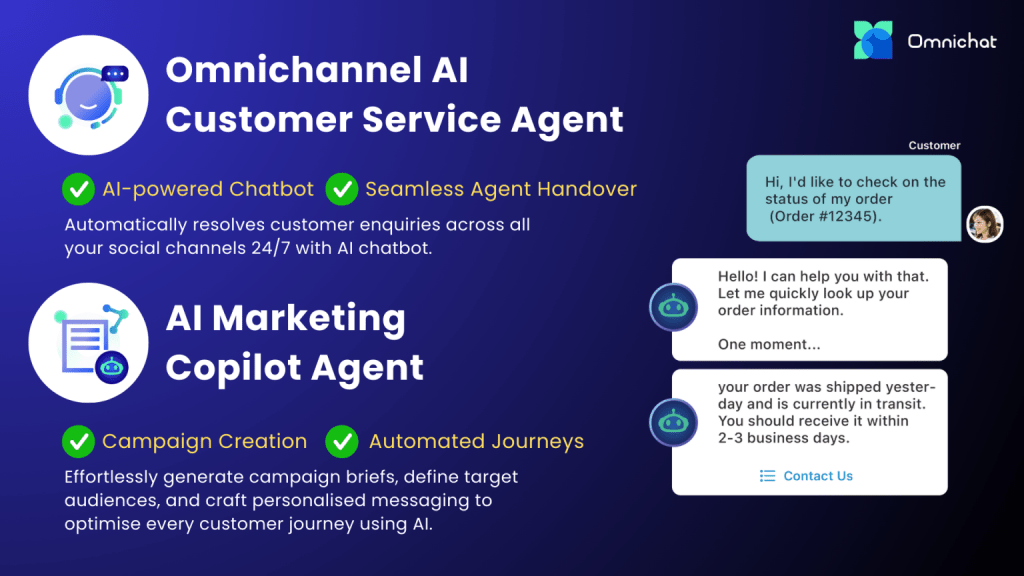
– Omnichat applies AaaS within its all-in-one messaging platform through its AI Customer Service Agent, AI Marketing Copilot Agent, and AI Shopping Agent to support customer engagement, marketing, and sales workflows across channels.
While generative AI focuses on the creation of text, images, or code, Agentic AI extends beyond content generation. In this framework, the Agent can execute tasks, trigger actions, and coordinate processes to achieve defined objectives. This article explores what AaaS is, its key features and benefits, and real-world use cases, including applications of AI customer service agents, marketing copilot agents, and AI shopping agents across retail and other industries.
What is Agentic AI as a Service (AaaS)?
Agentic AI as a Service (AaaS) refers to cloud-based AI solutions that are provided on a subscription basis. Unlike traditional AI projects that often require significant upfront investment in hardware, software, and specialised personnel, AaaS allows companies to access and deploy pre-built, customisable AI agents that can perform specific tasks or workflows.
Agentic AI is an artificial intelligence system designed to accomplish defined objectives with limited supervision. It consists of AI agents that mimic aspects of human decision-making to solve problems in real time. These agents are designed to act autonomously within defined parameters, making decisions and taking actions to achieve specific goals.
Modern agentic systems are typically powered by large language models (LLMs), which provide the reasoning capability that enables agents to interpret context, plan next steps, and execute workflows across connected systems.
Think of it as renting a team of highly skilled AI specialists rather than building your own from scratch.
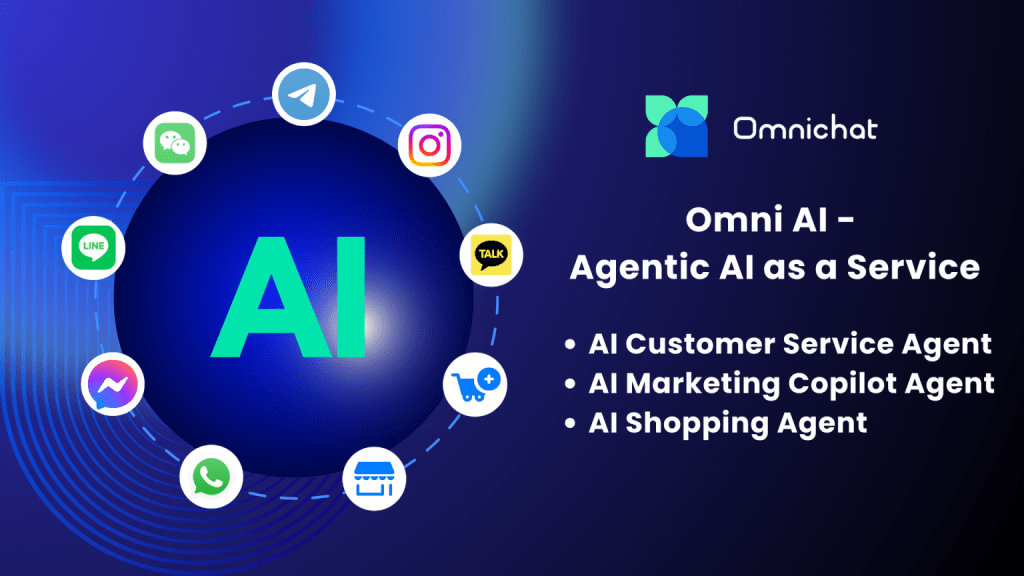
Omnichat also incorporates Agentic AI as a Service into its all-in-one messaging platform:
- AI Customer Service Agent autonomously engages customers across multiple channels 24/7, swiftly and accurately resolving cases with customised prompts and knowledge bases that align with brand identity.
- AI Marketing Copilot Agent creates marketing campaigns easily and effortlessly, from audience targeting, content drafting to customer journeys building based on previous interactions, and customer analysis. Performance metrics can be evaluated to ensure KPIs are met, with proactive recommendations for improvements.
- AI Shopping Agent automatically recommends tailored products and services to customers through their preferred messaging platforms. It streamlines the sales cycle, enhancing conversion rates by guiding search queries, personalising product recommendations, and facilitating payments.
AaaS vs. SaaS vs. PaaS
| Model | Explanation | Example |
| Software as a Service (SaaS) | A complete, ready-to-use application delivered over the internet. Users interact with a pre-built interface and have limited control over the underlying infrastructure or code. | Salesforce, Mailchimp, Google Workspace |
| Platform as a Service (PaaS) | A cloud-based platform for developing, running, and managing applications. Developers have control over the applications they build, but not the underlying platform infrastructure (servers, operating systems, etc.). | AWS Elastic Beanstalk, Google App Engine, Microsoft Azure |
| Agentic AI as a Service (AaaS) | Cloud-based AI functionalities (intelligent agents) provided on a subscription basis. Provides functionality, not a complete application or a development environment. Businesses integrate these pre-built, customisable AI agents into existing software or workflows via APIs. | Omnichat (AI customer service agents, AI marketing agents, AI sales agents) |
Key Features of Implementing Agentic AI as a Service
- Scalability: Businesses can easily scale their AI usage up or down as needed, paying only for the resources they consume. This is particularly beneficial for companies experiencing rapid growth or fluctuating demand.
- Cost-Effectiveness: AaaS eliminates the need for substantial upfront investment in AI infrastructure, hardware, and specialised staff. The subscription-based model makes AI accessible to a wider range of businesses.
- Flexibility and Customisation: AaaS solutions are often highly customisable, allowing businesses to tailor the AI agents to their specific needs and workflows. This can involve configuring pre-built agents or developing custom agents using low-code or no-code platforms.
- Ease of Integration: AaaS solutions typically rely on APIs, making it relatively straightforward to integrate them with existing business systems, such as CRM platforms, marketing automation tools, and e-commerce platforms.
- Continuous Updates and Improvement: AaaS providers are responsible for maintaining and updating the underlying AI models, ensuring that businesses always have access to the latest advancements and performance improvements. The agentic AI can often learn and improve based on every interaction.
Benefits of Agentic AI as a Service with Minimal Human Intervention
- Faster Deployment with Lower Costs: AI solutions can be implemented much more quickly compared to traditional AI projects while the expenses associated with developing, deploying, and maintaining in-house AI capabilities are significantly reduced.
- Increased Efficiency: Agentic AI automates repetitive and complex tasks, relieving human teams from routine work and enabling them to focus on strategic, high-value activities. Agentic AI can also operate with minimal human supervision, autonomously handling business processes and adapting to changing requirements.
- Improved Decision-Making: AI-powered insights provide a data-driven foundation for strategic and operational decisions.
- Enhanced Customer Experience: AaaS enables personalised customer interactions, proactive support, and more efficient service delivery.
Use Cases of Agentic AI as a Service
E-commerce & Retail
- AI Customer Service Assistants: Platforms like Omnichat leverage AI-powered assistants to handle customer enquiries, process orders, and manage returns seamlessly via WhatsApp and other popular messaging channels. This 24/7 availability improves response times and frees up human agents to focus on more complex issues.
- AI-Driven Marketing Automation: AI marketing agents can analyse vast amounts of customer data to create hyper-personalised customer journeys, automatically triggering targeted messages and offers based on individual behaviour and preferences.
- AI-Generated Content (AIGC): Streamline content creation with AI. Generate compelling ad copy, engaging social media posts, and personalised email newsletters – all tailored to resonate with specific customer segments.
- Personalised Product Recommendations: Boost sales and customer satisfaction with AI-powered recommendation engines. These systems analyse customer browsing history, purchase patterns, and preferences to suggest relevant products, increasing the likelihood of conversion.
Healthcare
- Automated Administrative Tasks: AI agents can streamline the management of medical records, appointment scheduling, and other administrative tasks, reducing paperwork and freeing up valuable time for medical professionals.
- AI-Driven Diagnostics: Advanced AI algorithms can assist doctors and specialists in identifying diseases earlier and more accurately, leading to more effective treatment plans. Agentic AI can also accelerate drug discovery by analyzing medical records, research papers, and clinical trial data to help identify new medications.
- Predictive Analytics for Patient Care: Leverage AI to analyse patient data and predict potential health risks, allowing for proactive interventions and personalised care plans. Agentic AI leverages natural language processing to interpret unstructured data and analyses data from various sources to further improve patient outcomes and reduce hospital readmission rates.
Finance & Banking
- Automated Customer Support: AI assistants (AI chatbots) provide instant responses to routine customer enquiries, improving service availability and reducing wait times. Agentic AI systems incorporate human feedback to continuously improve service quality and adapt to evolving customer needs.
- AI-Powered Fraud Detection: Sophisticated AI algorithms can detect and prevent fraudulent transactions in real-time, protecting both the institution and its customers.
- AI-Driven Risk Analysis: Utilise AI to assess risk more accurately for loan applications and investment decisions, leading to more informed and profitable outcomes. Agentic AI leverages reasoning models and reinforcement learning to improve decision-making and adapt to new financial risks over time.
Manufacturing & Supply Chain Complex Workflows
- Demand Forecasting: AI-powered forecasting tools analyse historical data and market trends to predict future demand accurately, enabling optimised inventory levels and production planning. This minimises waste and ensures that businesses can meet customer needs effectively.
- Quality Control: Computer vision systems, powered by AI, can identify defects in products with far greater speed and accuracy than human inspectors, improving product quality and reducing waste.
Agentic AI as a Service represents a significant step forward in making AI accessible and practical for businesses of all sizes. By providing pre-built, customisable AI agents, AaaS lowers the barriers to entry for AI adoption, enabling companies to leverage the power of AI without the need for massive upfront investments or specialised expertise.
Book a Consultation